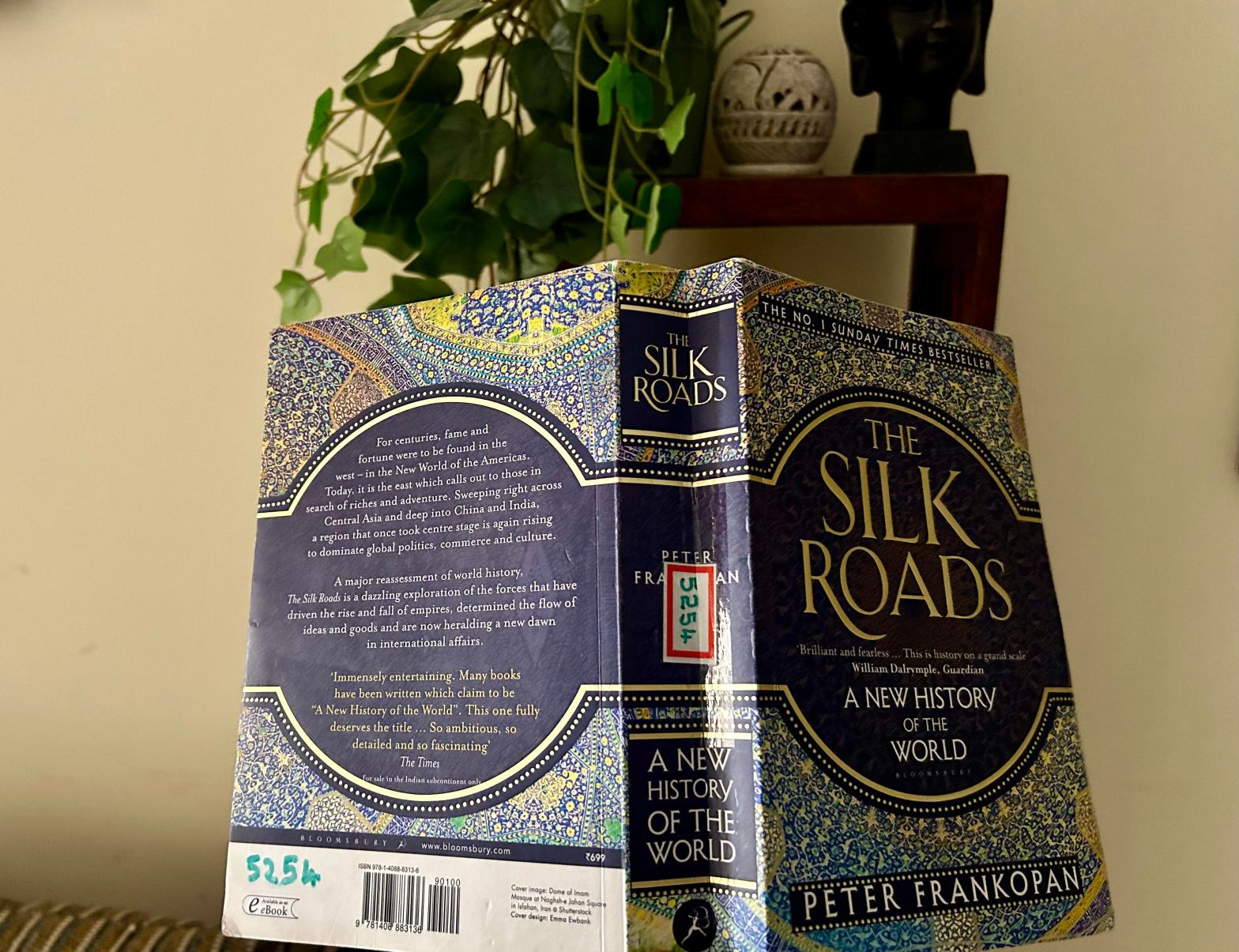
Hope the first part of my review for this book got you excited about the brief history of the center of the world and the learnings we could take from the past. If you haven’t read the Part-1 of this blog yet, I recommend you read it first to set the right context. In this second part, I like to cover the two other aspects that I found very interesting in Peter Frankopan’s fantastic book: First is the story of some historic cities, some lost in time, some re-emerging with greater glory than its past. Second is the story of the religions that flourished in this region, the influences, conflicts and co-habitation.
Historic Cities: Over the course of history, a lot of cities have been built and razed. Peter visits the idea behind the new cities being built, and it’s interesting to see what they have become today. Geographical importance played the main role in building of these cities. The curiosity he generates around how and when some historic cities were built and sustained fits in so naturally in this amazing flow of historic events.
- Alexandria: Alexander the great was an energetic founder of new cities, mostly naming them after himself. Herat (Alexandria in Aria), Kandahar (Alexandria in Arachosia) and Bagram (Alexandria ad Caucasum). In 332 BC, he founded Alexandria on the Mediterranean coast of Egypt. It was the largest city in the ancient world before being eventually overtaken by Rome. Today it’s the second largest city in Egypt (after Cairo). Once a major center of Hellenic traditions during Greek era, today it’s the fourth largest city in the Arab world.
- Constantinople: A splendid new metropolis was built by the Romans on the banks of Bosporus, in the old town of Byzantine. Roman emperor Constantine envisioned this to be the eventual capital of the Roman Empire, due to its proximity to the source of wealth. Although it was called “New Rome”, it was soon renamed to “Constantinople” in honor of the city’s founder, and quickly surpassed Rome for its grandeur and importance. Located strategically at the meeting point of Europe & Asia, it became the largest & most important city in the Mediterranean during the 4th century. Once the capital of the Eastern Christian Roman Empire, today we know this city as Istanbul.
- Zhongdu: In a series of attacks starting in 1211, the Mongols attacked the erstwhile Jin dynasty and sacked their capital city Zhongdu. After the great Khan Guyug died in 1248, and mongols went through succession struggle, the Mongols decided to give up on Europe, which they thought was not worthwhile & focus more on the better targets in the east. They consolidated what remained of China, and in late 13th century the ruling Mongol dynasty adopted the imperial title of Yuan and founded a new city on the old city of Zhongdu. Capital of the Mongol empire, geographically in the best position to take control of the region between the Pacific and the Mediterranean, today we know this city as Beijing.
- Madinat-al-Salam: The Muslim conquest led to the annex of structural cities from Rome and persian empires in the 7th-8th century. This new wealth from taxes and trades flooded into the coffers of the Muslim empire, leading to building of larger cities. An enormous new city was constructed along the Tigris River, that became the richest and most populous city in the world & remained so for centuries. It was known as Madinat-al-Salam or the city of peace, today we know this city as Baghdad. Mongols eventually sieged and destroyed this city in 13th century, and more recently the US invasion of Iraq has left this city completely devastated.
- Fatehpur Sikri: Built in the 2nd half of the 16th century, as a new capital for the Mughal Empire, this city hosted a series of courtyards and buildings built from red sandstone, blending styles and designs from Persia/Central Asia with those of India to create a splendid court. Although Emperor Akbar’s grand plan of moving the capital to Fatehpur Sikri didn’t eventually materialize, the place is now serves as a popular tourist destination, less than an hour drive away from its more glorious cousin, Agra, home to the world-famous Taj Mahal. I visited Fatehpur Sikri in December 2023 and found the monuments Buland Darwaza & Diwan-e-khas to be absolutely brilliant. Sadly though, the place around these monuments is not taken care of, filled with unscrupulous tour guides, hawkers & beggars, making the experience not so nice.
- Manila: In 1571, the Spanish arrived in Manila and changed the global trade. Spanish, by this time, changed their character from conquest to colonization. Manila became an emporium where a rich array of goods could be bought. Strategically located between Asia & the Americas, goods could now move across the Pacific without passing through Europe first. It was, in the words of one modern commentator, ‘the world’s first global city’. Today, it is the most-populous region in the country, one of the most-populous urban areas in the world, and one of the wealthiest regions in Southeast Asia.
- Timbuktu: Western Africa was referred as the “Land of Gold” by the early Muslim writers. Timbuktu, in particular grew in importance, as it became an important commercial center & hub for artists by early 14th century. Timbuktu’s location at the meeting point of desert and water made it an ideal trading center. In the late 13th or early 14th century it was incorporated into the Mali empire. Mansa Musa, the king of Kings of the Malian empire was looked up in awe while he spent lavishly on himself and the grand palaces. He wore gold skullcap and took expensive presents during pilgrimage to Mecca. Now a shadow of its former glory, Timbuktu—in modern-day Mali—strikes most travelers as humble and perhaps a bit run-down.
- Astana: Major new urban centers have been founded in Central Asia in recent years. A new capital city for Kazakhstan, Astana, rose from the dust in less than twenty years. The spectacular palace of Peace and Reconciliation and other grand infrastructure projects in the city are a testament to the wealth in this part of the world. Peter ends the book noting the rise of “The New Silk Road“, or the Chinese call for a “Silk Road Economic Belt‘ – linking China and Russia to the upcoming powers in central Asia – with states like Kazakhstan and Uzbekistan, Kyrgyzstan and Turkmenistan, Tajikistan and the countries of the Caucasus, reclaiming their position as the true centers of the world geography.
Spread of Religion: The way Peter weaves his magic to trace the paths and flow of religions, majorly through the Silk Road is incredible. He exquisitely delivers a narrative on the rise and fall of religions, and I simply loved this part. Along with the goods, ideas too flowed along the silk road, the most powerful idea was that of the divine, and “god” transcended boundaries. However, in due course of time, the concept of God became more political & a feeling arose that a society protected by the right god prospered, else suffered. Leaders understood the societal tendencies & built lavish places of worship, giving them greater control of people. Joining hands with priests gave them moral authority. All empires followed this “god-like-king” approach to control its people.
- Buddhism: First to move around were the Buddhist concepts, especially after Emperor Asoka of Mauryan dynasty in India, heavily patronized Buddhism. Menander, the king of Bactria (Ancient Iran), along the Hindu Kush mountains, was persuaded by an inspirational monk to accept Buddhism as state religion. Buddhism spread from Northern India along the trade routes in the 1st century AD. By 4th century, sacred Buddhist sites were all over Xinjiang. Northern Wei in mainstream China promoted Buddhism in large scale, competing against Confucianism that was deep rooted back a millennium. Buddhists had refrained from visual representations until the cult of Apollo, the Greek god of music and divination, established in the Gandhara valley and Western India. Statues of Buddha now started to appear, with Apollo serving as a competition and major influence.
- Zoroastrianism: Zoroaster – the great Persian prophet taught that the universe was divided to two principles, Ahura Mazda (Illuminating Wisdom) and its antithesis, Angra Mainyu (Hostile spirit), which were in a constant state of conflict. Ritual purification, mainly through fire was sought. Ardashi I & his successors promoted Zoroastrianism under the Sasanian dynasty, which expanded aggressively. Zoroastrianism had a robust set of beliefs that were entirely in line with a militaristic culture of imperial renewal. Other religions were ferociously attacked in Persia during 224 AD. The religion expanded at the expense of Jews, Buddhists, Hindus, Manicheanism, and no other ideas were tolerated. 3rd century Persia was conscious and wary of Christians that was spreading in the region, much like Buddhism in east. Initially at war with Christian Rome, finally succumbed to the Islamic invasion.
- Christianity: Although now considered a western religion, Christianity was initially adopted by Asians. Born in the little town of Bethlehem, Christianity became the most competitive and successful religion, making inroads across Asia, at the expense of Zoroastrianism, Judaism and Buddhism. Romans initially persecuted the Christian population, mostly from the east. However, fortunes changed when Royalty extended their allegiance to the new faith. Armenian king Tiridate III converted to Christianity in 4th century. The religion got its biggest boost when Roman Emperor Constantine converted to Christianity. Interestingly though, this was out of shrewd politics, as it was the faith adopted by his military. He abolished the oracles & other features of Roman Theology, promoted the Christian beliefs and became the protector of the Christian faith. Rome’s constant war with Persia and later the rise of Islam meant the eastern Christians got persecuted and this eventually compromised the religion in the east. But the platform was good enough for the religion to expand along the Pacific and the Atlantic.
- Judaism: Evolved from Yahwism, an ancient Semitic religion of the Iron Age, around 6th/5th century BCE, Judaism is considered to be one of the oldest monotheistic religions. Competition for spiritual authority became intense after the birth of Christianity, and Jewish attitudes to Christians hardened in Persia. In the kingdom of Himyar (South-west of Modern-day Saudi Arabia & Yemen), Jewish community became very prominent and the Kingdom of Himyar adopted Judaism as state religion. Christians in the state and neighboring Ethiopia got persecuted and martyred for their Christian beliefs. The religion found success in the Khazar society, a Turk tribal grouping that dominated the area north of the Black and Caspian Seas, in modern day Ukraine and Southern Russia. In the middle of the 9th century, the Khazars decided to convert to Judaism.
- Islam: Islam was born at a time when the society was ripe for its preachings. The Persian-Roman wars had rampaged the society, and in 541 AD, Bubonic Plague devastated the Mediterranean Constantinople & Persian Mesopotamia. Islam gave the Arabs their own religion and new identity: Faith designed for the local population, whether nomad or urban, one tribe or another, and Unity became the core tenet of the religion. Mass conversion followed mostly due to two reasons. First, the promotion that the new faith was just an heir to the Christianity & Judaism doctrine and not radically different, as Peter writes “Muhammad’s revelation had previously been revealed to Abraham and Ishmael, to Isaac and Jacob, same message to Moses and Jesus too. Prophets of Judaism & Christianity were the same as those of Islam“. Second, a great strategy for conversion was the willingness to sanction material gain in return for loyalty & obedience. “Goods could be seized from the non-believers by the faithful: A pyramid system where the ones who converted early were rewarded with proportionally greater share“. Arab conquests, however, weren’t brutal, to start with. Syria and Palestine surrendered, with Christianity being allowed to be practiced, just agreeing to the overlordship of new masters. Same thing happened in Iran & Egypt. New cities were founded by Muslims, and tolerance was observed to Christians and Zoroastrians in the region. However, in the late 7th century, the tolerant attitude changed, mostly due to the rival factions within Islam, each trying to “prove” their faith; other religions bore the brunt of this internal power struggle.
- Manichaeism: Mani, a charismatic 3rd century prophet blended ideas from the east and west and founded a new religion Manichaeism. His teachings were once championed by Shapur I of the Persian empire, but under Ardashir rule, intolerance reached its peak with Mani and his followers being mercilessly hunted down and killed. After Arab conquerors defeated the Chinese by the Talas River in Central Asia, Uighurs also converted to Manicheanism, a middle ground between Islamic world on the west & China to the east. Eventually the religion lost its foothold and significance.
- Tengri: Nomadic tribes like the Mongols and Turks worshipped the Supreme deity of the traditional Steppes – Tengri. From Wikipedia: The core beings in Tengrism are the Sky Father (Tenger Etseg) and the Earth Mother (Umay Ana). Tengri was the chief deity worshipped by the ruling class of the Central Asian steppe peoples in 6th to 9th centuries (Turkic peoples, Mongols and Hungarians). It lost its importance when the Uighuric kagans proclaimed Manichaeism the state religion in the 8th century. The worship of Tengri was brought into Eastern Europe by the Huns and early Bulgars.
There is a lot of food for thought, especially for the lovers of history, geopolitics and religion studies. This book is a glorious chain of events that has led us to the state of affairs we are in today; an amazing telling of history on a global scale – narrated in an emphatic and grand literary piece. History belongs to the historians!
Discover more from Keep it simple, stupid.
Subscribe to get the latest posts sent to your email.
 Keep it simple, stupid.