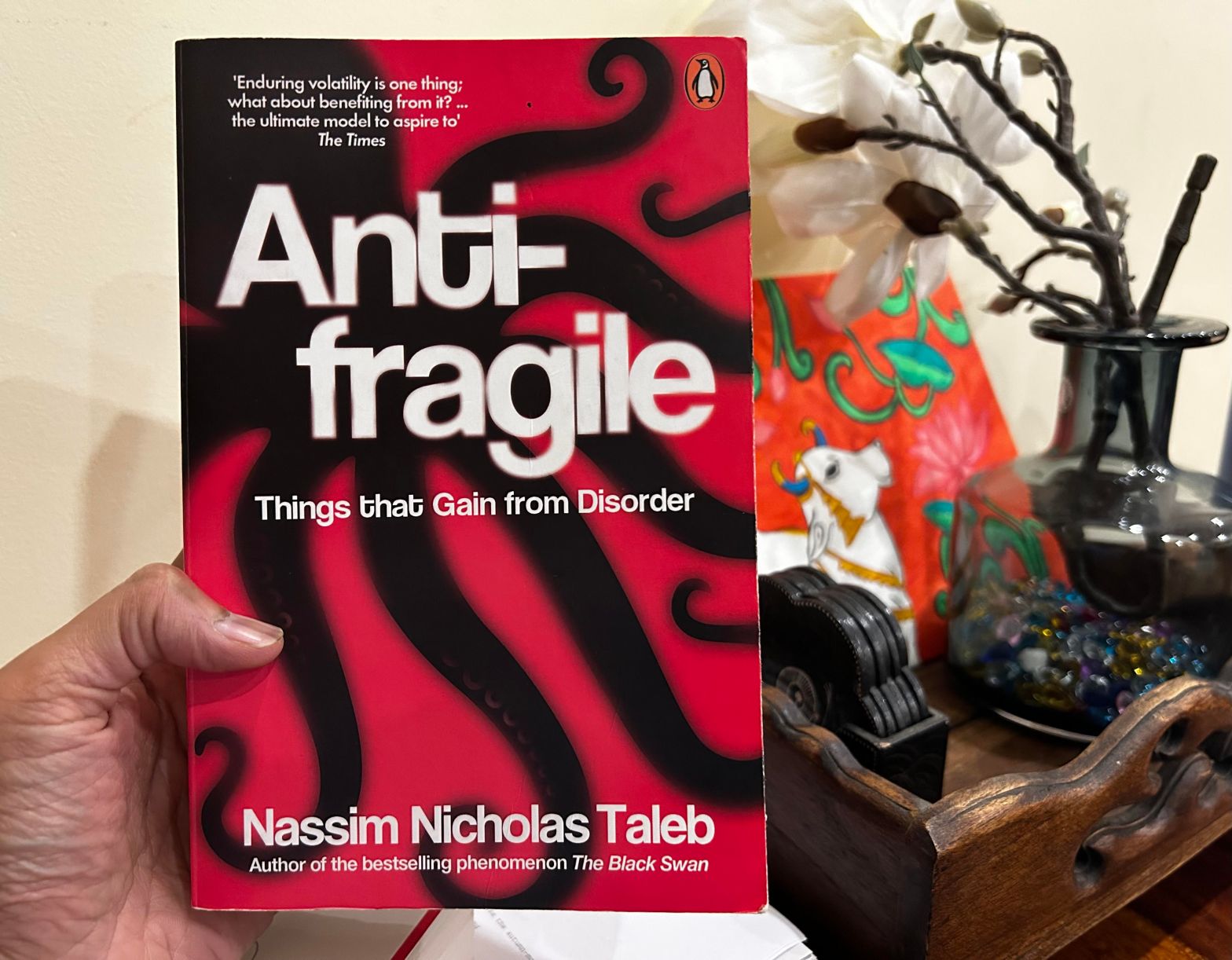
This book by Nassim Nicholas Taleb had been on my must-read lists for a long time. During a visit to one of my friend’s homes, I chanced to see it on his bookshelf and requested him to lend it out to me. It took me a long time to complete this book though, mostly due to unwarranted breaks, context switches and some chapters requiring too much focus. The book was quite good, with lot of interesting thoughts, anecdotes of the past philosophers and other curious personalities, peppered with some personal experiences of the author. Some chapters, especially the final two are easy to read, but most of them not so much. Before I return the book back to my friend, I wanted to jot down some interesting aspects that came up on the book, something to truly ponder about.
Antifragility: Taleb talks about a triad consisting of Fragility, Robustness and Antifragility. Before reading the book, I assumed antifragile means one that’s not fragile. Taleb’s definition goes a step further: Antifragile is something that gets better when exposed to stressful conditions. The one that’s not fragile, and doesn’t get damaged under external pressure, is just Robust. He cites examples for a high-level understanding of these terms. In the Roman recycled version of a Greek myth, Sicilian tyrant Dionysius II has courtier Damocles enjoy a luxurious life, but with sword hanging on his head, with just a single hair from horses’ tail. Damocles is clearly fragile; one snap and he gets off the gene pool. Then there is the Greek recycling of ancient semitic/Egyptian legend, Phoenix, the bird that comes back to life after burnt down to ashes. Interestingly, Phoenix is also the symbol of Beirut, where the author originally comes from. Berytus (Beirut’s historical name) has been destroyed seven times in its 5000 years history and has come back to life all seven times. Beirut and Phoenix are clearly robust. And then we have Hydra, the serpent-like creature from Greek mythology that lives in the lake of Lerna, near Argos and has many heads. Each time one head is cut off, two heads grow back. It grows stronger when it gets attacked – a perfect example of Antifragility. This reminded me of Raktabeeja, the powerful Asura in Indian Mythology, who got a boon from Shiva that each drop of his blood falling on the ground, turns into more demons with equal strength and power – Antifragility at its best.
Antidotum Mithridatium: Taleb writes about an interesting process called Antidotum Mithridatium, one in which people build immunity against a harmful substance by continuously exposing themselves to the substance in small doses over a long period of time. Eventually, they are not affected when administered with larger quantities of it – they are robust against this poison. The name is derived from King Mithridates IV of Pontus in Asia Minor, who ingested sub-lethal doses of toxic material in progressively large quantities. This method was later celebrated as Antidotum Mithridatium by Celsus, ancient world’s famous doctor. I have heard stories of people ingesting snake venom in small doses over a long period to gain immunity from snake bites. It is believed that Chanakya, the advisor to Emperor Chandragupta Maurya, fed the emperor with small doses of poison to build his immunity against poisoning attempts by his enemies.
Hormesis: Taleb writes about another interesting term called Hormesis – a word coined by pharmacologists when small dose of harmful substance actually proves beneficial for the organism, and higher doses can be toxic. In 1888, German toxicologist Hugo Schulz, observed that small doses of poison stimulated the growth of yeast while large doses caused harm. Some researchers interestingly theorize that the benefits of vegetables are not so much due to the “Vitamins” they contain. Plants protect themselves from predators by releasing poisonous substances. And when we eat these plants in right quantities, it stimulates our body – classic case of Hormesis. I am a hygiene freak, where I have to wash my hands often, and with handwash most of the times. It became even more acute during the covid-19 period, and I believe this turned out to be the case for lot of us. When we overdo this, we miss out taking in the right amounts of “poison”, in the form of bacteria (good and bad). Taleb rightly points that beyond a certain point, Hygiene makes us fragile by denying hormesis. I got further info on the Wikipedia where it’s noted that best example of Hormesis is oxygen, which in limited quantity is pure “oxygen” to the lungs; an overdose though is toxic. There is a hormetic curve graph with three zones: Deficient, Hormetic and Toxic. Physical exercise can be beneficial when done regularly. Exercising less is not good and exercising too much can also be dangerous.
Celebrate Fasting: Taleb believes that science doesn’t have answer to everything that we struggle with. We can seek refuge in religion in this case. One of the nice things done in most religions is fasting – going without food, and sometimes without water for long hours and days. The body is put under stress (hunger) for long duration, and this is good in the long term. In our day-to-day life, we have fixed schedule for the meals of the day, and Taleb points out that too much regular food is bad for you, this way we deprive humans of the stressor of hunger, this in turn makes individuals live less than their full potential. We need to celebrate fasting, even if one is not religious. For the folk’s bent on scientific evidence, there is this concept of Autophegy – where the bad proteins are broken down first and recycled by the body during starvation. We deprive body of this Autophegy process with regular food intake. “Sometimes scantiness of nourishment restores the system” wrote Plotinus. The regimen of Salerno school of medicine was joyful mood, rest and scant nourishment. Pomponius Atticus, a prominent Roman figure, who got diagnosed with severe disease, tried to end his life by abstinence of food. Interestingly, this abstinance restored his health! This is why I think the recent trend of intermittent fasting is here to stay – it’s truly effective.
Modernity: Most of us live under highly controlled environments lately; comfortable at the safe confines of our homes – We don’t need to go hunt for food; in fact we don’t even need to go outside thanks to home-delivery, quick commerce is perfect! But as Taleb puts it, we humans were not meant to eat without working hard for it (I mean not working hard at office or that stressful project). We need some physical work, for our body to soak in those nutrients. We live in a comfort crisis, where a small variation of our expectation makes us go crazy – we are scared of randomness, instability and failures. Taleb writes that the excess energy released from overreaction to setbacks is what truly innovates. So now we know how the initial setbacks, the difficult childhood or youth might have led to eventual success of some of the people out there. Roman statesman Cato the censor, looked at any form of comfort as a road to waste. He rightly worried that it weakens the will. Studies found that even the best horses lose when they compete with slower one but win when put up against better rivals. So, the absence of challenge, the under compensation due to absence of stressors, inverse hormesis, all degrade even the best of the best. Unless, we get out of our comfort crisis, get out to take failure head on, we will continue to be in the fragile mode.
Ageing: Human body self-repairs, but then eventually will get worn out. Taleb writes that the failure to self-repair comes largely from Maladjustment – Either too few stressors or too little time for recovery between them. “Ageing” is a combination of maladjustment and senescence. The biological process by which a cell ages and permanently stops dividing is called Senescence, and this might not be avoidable, and actually should not be avoided – this is against the law of nature. But maladjustment can be avoided. Stressors are required in right amounts; more stressors will cause more harm than good. Taleb is amused how lot of people just want to live longer life – He questions this human desperation towards immortality. His thoughts – we are here for a while, and while we are here, we need to ensure the human race moves along, so we write books, make videos and pass on our genes and knowledge to the next generation – that’s all – not to live forever. As an individual, we are fragile, but collectively as Homo Sapiens, we tend to achieve Antifragility. We just need to do our part here and leave!
Iatrogenics: The damage caused due to excessive treatment is called Iatrogenics, which literally means “caused by the healer”. Iatros refers to “healer” in Greek. Taleb excessively bashes the big pharma industry and the medical profession for unnecessarily intervening the natural healing process. To be honest, in today’s world, even the patients themselves dont have the time to “suffer” and undergo the natural process. So, the patient and the doctor go hand in hand to undergo medical treatment, even when it’s not required, endangering themselves, and sometimes even the human race itself. We know how the paracetamol and other fever reducing medicines are bad for the liver, but yet we take it just to “recover” soon. Even worse is the excessive use of antibiotics that breeds new generations of bacteria that are immune to these antibiotics (this is probably Mithradatium in action for the Bacteria). This could be catastrophic for the entire human race. I have taken the Vitamin D and B12 supplement pills, and this topic is ripe with controversies. Some say it’s definitely needed; some say as long as the body can function with lower levels, we should not intervene. In general, to be more antifragile, we should avoid medical intervention unless extremely necessary. Taleb does point that in severe medical cases, like critical stage cancers and trauma, there is definitely need for medical support, but not for mild ones.
The Barbell approach to everything: Another fascinating concept (lot of them in this book!) is about the barbell approach to life. Barbell is a bar with weights on both ends that weightlifters use. He writes that it’s always good to play it safe in some areas (which are robust to negative black swans) and take small number of high risks (which are open to positive black swans). Extreme risk aversion on one end, and extreme risk taking on the other, rather than the middle ground. In terms of finances, he recommends putting 90% into safe deposits, while 10% in maximum risky investments. In this case, you won’t lose more than 10%, while still having massive upside potential. If you put 100% into some medium risky investments, there is still probability to lose everything. Seneca had a very active, adventurous life, followed by philosophical withdrawal to write and meditate. Many of the “doers” turned “thinkers” do pure action first, and then pure reflection. Georges Simenon wrote only 60 days a year, spent 300 days doing nothing. He ended up publishing more than 200 novels. Taleb writes against the consistency of doing everything in balance every day. He recommends it’s good to have a balance of stress. I use a barbell like approach in my travel financing – I spend as little as possible for the transport and accommodation, while splurging on the food and activities – works well for me overall, rather than looking to do everything in medium.
Skin in the game: Taleb wrote another book on this topic, and I simply love this! After knowing about this term recently, I pretty much use it all the time. It’s very clear – As long as someone doesn’t have skin in the game, don’t listen to a word of what they say. If someone is preaching something, see if they are actually following that. There are lots of instances. People sitting in the safe confines of their home, advocating for war or invasion. If you don’t have a family member in the army, and you are not directly affected by the war, it’s very easy to say, “Let’s go to war!”. Dynamics changes when a close family member is either in the army or personally impacted from the war. Psychologist Gerd Gigerenzer has a simple heuristic – Never ask the doctor what you should do. Ask him what he would do if he were in your place. We will be amazed at how the response changes. Economists who forecast numbers and upsides/downsides need to show their investment portfolio. Believe them only if they have their skin in the game. Quite recently, when we keep talking about investing in stock market, we talk about putting in higher amount in the stocks that we invest on. With lower amounts, we don’t have enough skin in the game and won’t be impacted whichever way the stock moves. It’s also like the CEO who has been quite bullish on the company, pushing the agenda that all is great, stock prices will go up, and then shocking everyone with his or her resignation – this is yet another example of no skin in the game. This is a very important concept to understand in all forms of life. Putting everything under the “skin in the game” lens is extremely important to achieve antifragility.
Soul in the game: Next, Taleb goes one step further. To some people, it’s not just skin in the game, it’s their complete soul that is on the line. Prophets might not be the one who first had an idea, but he is the first to believe in it and take it to conclusion – this involves a commitment beyond words. This applies to all the people who evangelize an idea, a theory. They believe it to their core, and their life, credibility and reputation is on the line. They have everything to lose, should this not go well. Freedom fighters, Writers, Business owners, activists, Soldiers, etc., most of them have a lot to lose. One thing Taleb points out that the gladiators of Rome, well, most of them were volunteers, not slaves. They put their soul into every fight, and that made it more appealing to the Roman audience. It was all or nothing approach, this is simply next level of “soul in the game”.
Talkers vs Doers: Taleb is completely against talkers, he rightly suggests we should celebrate doers. There is a very nice quote credited to Carl Jung: “You are what you do, not what you say you’ll do”. Throughout the book he talks highly of a doer called Fat Tony, who hates “tawkers”, and believes in just doing. Taleb writes about an entrepreneur being someone who “does”, lays down his time and life into something worthwhile for the human generation as a whole. Some succeed, while some fail. The successes are celebrated, but failures not so much. He writes we should honor all these doers, ones that “burn” themselves as individuals for the progress of the collective “human race”. He recommends celebrating an entrepreneur’s day, as a mark of respect to all such individuals. They are the backbone of the Antifragility that has taken the “Homo Sapiens” gene over for several centuries.
True Indicator of wealth: Finally, one of the most interesting sections I read was about what true wealth really meant. Taleb writes that True Wealth is about worriless sleeping, clear conscience, reciprocal gratitude, absence of envy, good appetite, muscle strength, physical energy, frequent laughs, no meals alone, no gym classes, some physical labor (or hobby), good bowel movements, no meeting room, periodic surprises, it is largely subtraction (elimination of iatrogenics). We need to work towards subtraction (removing unwanted things) rather than addition for most things in life!
There you go, these were some of the points that I managed to jot down and reflect from the book. Clearly, I might have missed few others. Do let me know in comments, if you believe I should include something else that you found important or interesting from the book. Happy reading and contemplating!
Discover more from Keep it simple, stupid.
Subscribe to get the latest posts sent to your email.
 Keep it simple, stupid.