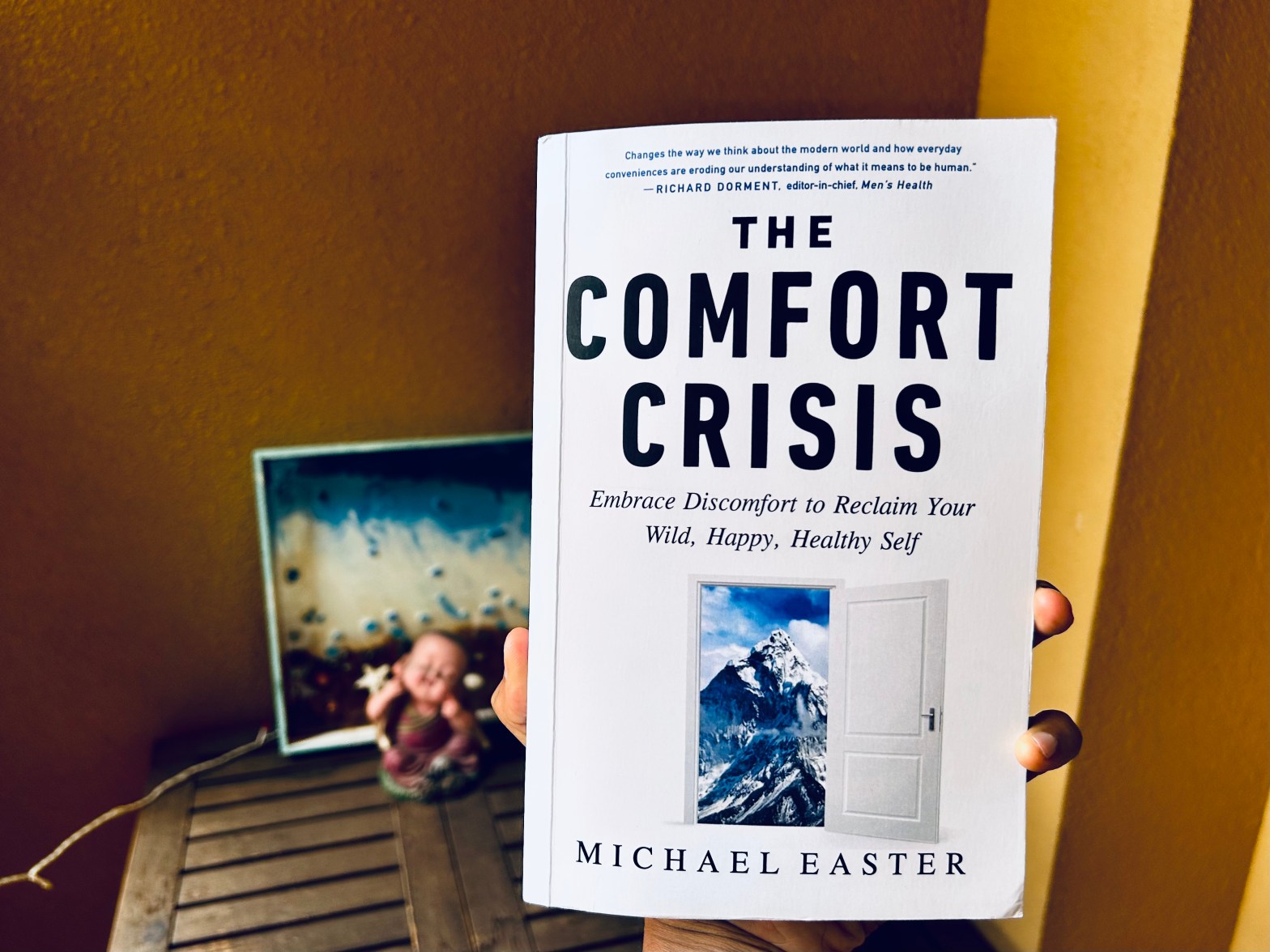
I just finished reading (and re-reading) yet another amazing book for this year – “The comfort crisis” by Michael Easter. When my friend suggested this book last year, I assumed it was a regular self-help book dealing with mental fortitude. But it turned out to be a glorious amalgamation of story, statistics and studies on physical endurance of the “Homo sapiens” species. Michael Easter brilliantly explores how our mind is fooling us on our own physical capabilities – Our bodies can in-fact endure much more than we think it can. The book has an amazing narrative, divided into five fantastic parts, all taking an important concept home. This was easily one of the best reads for me in a long time and would highly recommend this book to everyone.
In each part of the five parts, Michael weaves a nice personal narrative together with the research studies to back his thoughts and reflections. He took up a 33-day challenge to live in an insanely inhospitable tundra at Alaska, living under extreme temperatures, amidst the unknowns, living the hunter gatherer life. His reflections over this uncomfortable tenure are priceless. One of my friends used to iterate “Be comfortable with the uncomfortable“. To me at the time, this meant only making the mind uncomfortable. But apparently, there is more value in getting our bodies uncomfortable and endure more. Overall, the gist of the book, to me is “Don’t listen to your mind; listen to your body“. Mind gets easily influenced by others, but body always speaks the truth – Listen and respect.
Part.1 Rule.1: Make it really hard and Rule.2: Don’t Die: Most of us live a highly controlled and comfortable lives, food is always there, comforts of life at our fingertips. Scientists are finding that certain discomforts protect us from physical and psychological problems like obesity, heart disease, cancers, diabetes, depression, and anxiety, even feeling lack of meaning and purpose. Michael points out that constant comfort is a radically new thing for Homo Sapiens – just 0.004% of the time our species have walked this earth (if we open the time scale to 2.5 million years when our ancestor Homo Habilis evolved out of the smartest apelike animals of the time). The sad reality is that although life span has increased, health span has gone down – living many years in ill health.
Misogi is a Japanese Shinto practice of ritual purification. Traditionally, it involves cleansing the body and spirit through physical endurance -going out and doing a hard task to mimic the challenges our environment used to naturally show us. It’s a circumnavigation of the edges of human potential. It’s not about physical accomplishment, it’s about what we are willing to put yourself through to be a better human. Misogi may lead to “flow” state. Lapsing into flow requires two conditions: The task must stretch a person’s limits, and it must have a clear goal. The flow state is a key driver of happiness and growth, having the potential to make life more rich, intense and meaningful.
Structuring Misogi: Dr. Marcus Elliott, a Harvard-trained physician, was one of the top ten world triathletes of his time. Although he quit triathlons once he joined the medical school, all the solitary time running, riding or swimming – becoming comfortable with discomfort, had modeled his psyche. “Endurance sports gave me some understanding of what it is to push to deeper levels and find new layers within myself” he told the author. Elliott owns P3, a sports science facility that uses deep biometric data to improve pro athletes’ performance. He conducts Misogi, and in his model, there are only two rules – Rule one is that it has to be really hard. Rule two is that you can’t die. The general idea is that you should have a 50% chance of success – if you do everything right. Interesting point he makes is failure could mean that you die, even a hundred years ago. But today, people vastly overestimate the consequences of failure. Elliott further mentioned they had two more softer rules: One: The misogi had to be quirky and creative. Two: Don’t advertise misogi. It’s OK to talk about misogi to your friends and family, but you don’t tweet, Insta or Facebook or boast about misogi.
Misogi in mythology: The ancient mythology and history are filled with stories of misogi – where the hero or group of heroes are sent into Misogi’s, and they come back with depth of experience and confidence, and a clear sense of their purpose and place in the world. Buddha is a very popular example. While reading the book, my thoughts went into the Hindu Mythology, to the Ramayana epic, where we have Lord Ram, Lakshman and Sita being sent on exile, to live in dense forests, amidst wild animals, terrain and harsh nature, for 14 long years. They survived and came back with their minds completely rewired. Lord Ram chose to go, to endure the hardship voluntarily, stripped of his identity. It’s like the ultimate example of misogi: “A soul-cleansing trial that reveals who you are when everything else is stripped away.” In Mahabharata, the Pandavas are sent to exile for 13 years after losing the game of dice. Arjuna used the exile to grow, not just to survive. We have several other instances of devotees undertaking intense austerities – fasting, silence, meditation, resulting in boons being showered by the gods.
The Rites of Passage is a term coined by Van Gennep in 1909. During his work translating anthropological studies, in places ranging from the plains of Mongolia and North America to the islands of Fiji and Greece, he found the Men and Women in these cultures undertook a physical, nature-based rite of passage. Like venturing alone for 6 months into the Australian outback in the Aboriginal culture. Van found that these processes have 3 key elements: Separation, Transition and Incorporation. Separation means the person exits the society. Transition is about the person entering the challenging middle ground, where they battle with nature and their mind telling them to quit. Incorporation is when the person completes the challenge and reenters their normal life an improved person.
Population: Satoshi Kanazawa is an evolutionary psychologist at the London School of Economics. He has spent much of his career considering what happens to humans in our overbuilt, overpopulated environments. Research points that people who live in cities are 21% more likely to suffer from anxiety and 39% more likely to suffer from depression than people who live in rural areas. One of the interesting phenomena to explain this city/country happiness gap is the number 150. A group of roughly 150 people or fewer seems to be an ideal community – it’s called the Dunbar’s number, after British anthropologist Robin Dunbar who discovered it. He explained “Human societies contained buried within them a natural grouping of around 150 people“. Kanazawa believes that we still prefer our original group sizes. Life in rural and small towns more closely mimics the environments we evolved in. Kanazawa wrote “As population density becomes too high, the human brain feels uneasy and uncomfortable, and such unease and discomfort may translate into reduced subjective well-being”. He calls this idea the Savanna Theory of Happiness, and the general rule of thumb is, the higher the population density wherever a person is, the less happy they’ll likely be. Now we know why living in densely populated cities takes a toll on the human mind.
Solitude is something we all have to be good at but aren’t. It’s the capacity to be alone – “Essentially the ability to be alone with yourself and not feel uncomfortable or like you have to distract yourself” said Matthew Bowker, PhD, a professor of psychology at Medaille College. One interesting point that the author makes is that solitude has always been viewed as a punishment, be it solitary confinement in prisons or time-out for kids. Research backs solitude’s healthy properties – improves productivity, creativity, empathy and happiness, and decrease self-consciousness. We need to build a great relationship with ourselves and try to transform feelings of loneliness into feelings of rich solitude.
Part.2 Discover Boredom outside – For hours, days, months: People these days have lots of gadgets and sources to “conquer” boredom. But as the research says, boredom gets the “default mode network” fired up and our mind starts off wandering. Its the “Unfocussed mode” as compared to Focussed mode where the mind is at attention. Time in unfocussed mode is critical to get stuff done, tap into creativity, process complicated information, and more. Average person spends around 11 hours and 6 minutes a day using digital media – almost 50% of the time with cellphones, TV, audio and computers. These devices are stealing our boredom. While engaging with the digital gadgets, mind is in focused mode and doesn’t get the much-needed rest.
Social Engineering: B.J.Fogg, a Stanford psychologist wrote “Three elements must converge at the same moment for a behavior to occur: Motivation, Ability, and a Prompt“. Apps are apparently engineered based on this model; it’s called Fogg’s Behavior Model for obvious reasons. The evolutionary sequence of Trigger, behavior and a reward used for food earlier, has now been hijacked for boredom. Boredom triggers our behavior to check social media, the feed that follows serves as a reward. With the mobile phone in our hands, and all the apps in the world waiting to be triggered, the author rightly writes that Boredom has been killed.
Time in Nature: Screen time in itself is bad; even worse is that it’s taking away our time from nature. Biophilia hypothesis, a theory developed by famed biologist E.O.Wilson says we have an ingrained call to be in nature that’s in competition with our evolutionary desire to control our environment. Research from the University of Michigan discovered that 20 minutes outside, three times a week, is the dose of nature we need to drop the stress hormone cortisol. In nature, we enter a mode called “soft fascination” – lightly focusing outwardly on the nature around you – it’s very much like meditation. But this nature immersion has to be done entirely – not walk around inside the park engaged on a mobile phone. We need to admire the greenery, the shapes, sounds and smells of the nature in its entirety. Else the activity is of not much use. I frequently see people going for walks using their mobile phones, and I feel sad that they are not making complete use of this activity, unfortunately.
Forest Bathing: Shirin-yoku, a Japanese marketing term, translating to “Forest bathing” was introduced in early 1980’s, when Japan was becoming more concretized. It promoted walking or sitting in the woods and “taking in” nature. Japanese studies found that people who spent even 15 minutes doing forest bathing had plenty of health benefits. Even the folks with health issues came back with improvements. Any time we have anxiety, stress of any other ailments, let’s just take a walk amidst nature and come back rejuvenated. It doesnt have to be in the forests – it could just be the garden in your community, or a public park in the vicinity. Research in Finland suggests spending about 5 hours every month amidst nature.
Three-day effect: The author notes that if we go beyond the local parks, and maybe explore into deep forests or the likes, there is significant metamorphosis or transformation that occurs on day three. Three or more days in the wild is like a meditation retreat, he writes. One of the researchers took young students for four days camp, with no network coverage. He measured the brain waves and found the day-one was beta waves – frantic, type-A waves. But by day three it would be Alpha and theta waves – similar waves as found in experienced meditators. Time in nature truly calms our turbulent minds.
Silence: We don’t have real silence these days – city life is filled with honks, hustles and bustles. We need silence and darkness for a sound sleep. All other sensory inputs have been mostly removed, with less temperature swings, less smelling, wearing footwear making our foot feel less, etc. But our ears are constantly on, listening to all sorts of sounds, 24 hours a day. Apparently, the world’s number one killer, heart disease, isn’t just about the food and lifestyle. The constant stream of decibels is taking years off our lives. As and when possible, try to “rest” your ears, and maintain silence. I have seen folks constantly hooked onto the earphones for call or music, this really takes a toll on the ears itself, and general health as well. Silence could well be a solution to many problems in life!
Part.3 – Feel Hunger: We are never out of food these days (at least most of us). Worst is the mindless eating, due to stress, or boredom, or just because the food is out there. Japanese have a term for this “Kuchisabishii” which literally means “lonely mouth”. These extra calories are one of the major causes of illness. This, along with our inability to persist against the discomfort of hunger is increasing the obesity. Trevor Kashey, a young nutritionist talks about why do we process food? To keep food safe, transport to areas that doesn’t have it and to maintain the texture, flavor and nutrients. “Processing food is literally the cornerstone of human civilization” – let that thought sink in for a while. There is a lot of bashing for “processed” food out there, but then this processing itself has ramped the human population to 8.2 billion. Processed food is not always junk, he says. Junk food is unhealthy because its more calorie dense, less filling and we are more likely to overeat. He claims the biggest fat-loss hurdles is that gap between how much a person thinks they are eating and how much they are actually eating.
Hunger: There are two types of hunger: Real Hunger and Reward hunger. Real Hunger is when the body requires food to function – a physiological need. Reward hunger is spurred by environmental cue or a psychological need – because a clock says its lunch time, because its celebration time, or just because the food is there and why not eat it? Two types of hormones are at action in our body during hunger: Ghrelin is a hunger-inciting hormone produced when the stomach is running low on food. Leptin is a hormone that signals that we are full. The stress hormones cortisol and adrenaline are also released to let body focus on finding food. Once we eat, our brain release dopamine, rewarding us for the behavior. Ghrelin, apparently, isn’t so honest, it does spurt out even when full – especially when delicious, calorie-dense foods are around. This is the reward hunger: A drive to eat when we don’t actually need food. The reward hunger has evolutionary bias as the early humans didn’t know where the next meal was coming from and it made sense to stock up. But for the Humans of our era, this is a curse.
Stress: There are two kinds of stress: Acute and chronic. Acute stress is an alarm response, like a “jump scare” in a horror movie. Chronic stress is less intense but long lasting – there is a sustained slow drip of cortisol. We humans are the only beings “blessed” with chronic stress – because we are smart social creatures with an urge to be miserable to each other. Interesting point that Kashey tells the author is that “People who are at healthy weight don’t have better genetics or a higher metabolism, and they don’t magically burn more calories, they are just more likely to deal with stress by going for a walk instead of eating. Thats really the difference“. The next time you feel stressed, go for a walk. Distract the discomfort of reward hunger with discomfort of light exercise – it relieves more stress and promotes health.
Diet: What should a person eat? Well, there are several theories around this, and you be your own judge. We all agree that it has to be a balanced diet. Kashey mentioned “An average plate could be a quarter animal protein, a quarter whole grains or tubers, and half vegetables or fruit. Highly active people can do half whole grains or tubers, and a quarter vegetables or fruit“. The author reports studies conducted on the diet of healthy tribes. Kitavan people in Papa New Guinea have no obesity and zero indications of heart disease had in their diet “Cultivated tubers (mainly yam, sweet potato and taro) as staples, supplemented by fruits, leaves, coconuts, fish, maize, tapioca and beans“. The Tsimane people from Bolivia who register the healthiest hearts ever recorded eat rice, plantains, tubers and corn, meat and fish that they hunt themselves, fruit and occasional wild nuts. The chronic-disease free Hadza, in Tanzania, eat mostly wild tubers, fruits and meats. In the developed world, the Japanese, who stand out as longest living and low heart disease, eat rice, lean proteins and vegetables.
Benefits of fasting: We metabolize our last meal after 12 to 16 hours, depending on how much we eat. Body starts burning stored tissues for energy, and this process normally gets rid of a lot of dead and damaged cells. David Sabatini, a biologist at MIT, discovered what’s called the mTOR pathway – sensing whether your body is fed or not. When we go without food, this triggers a whole series of events that are rejuvenating and antiaging – our efficient body destroying the oldest, weakest cells. These are the cells that actively damage the tissues and promote aging. Autophagy the official name for the this “taking out the trash” process, is a translation from Greek word for “self-devouring”. To let this process work best, we have to fast for at least 12-16 hours every day (or maybe overnight). Try to eat at least 2 hours before sleep and have breakfast bit later (or skip it entirely depending on your weight reduction plan).
Part.4 – Think about death everyday: For the early humans, death was a daily reminder – diseases, animal attacks, environment, and facing the fury of the mother nature. We have been slowly moving away from death or at least delay it significantly thanks to the advances in engineering and sciences. However, death is an inevitable part of life, and the author shares thoughts from different cultures in the world that “celebrate” death. This also forms an important aspect of Stoicism, one that I penned down in my article: https://achuthkamath.com/2023/11/16/memento-mori/.
Happiest nation of the world: Bhutan, the tiny Himalayan kingdom neighboring India frequents the top spot as the one of the happiest nations of the world. The author met the top Buddhist monks of the country and understands how Bhutanese’s interest in death contributes to their feelings of happiness. The government appoints a Dasho, a special title for official whose is primarily the nation’s secretary of happiness. It all started in 1972, when King Jigme Singye Wangchuk studied the livelihood of all classes of his citizens and declared “Gross National Happiness is more important than Gross National Product“. Apart from the culture that accepts death for what it is, their source of happiness comes from the community connections, along with deep connections to the landscape. People are born at a particular place, live, work, and die there itself, imbibing a deep sense of belonging.
Fulfilling a checklist: Author met a mystic named Khenpo Phuntsho Tashi, the author of book called “The fine art of Living and manifesting a peaceful death“. He believes the world is out there trying to fulfill a checklist – Get a good spouse, a good car, a good house, then promotion, a better car and better house, etc. Another mystic Sogral Rinpoche, in his 1992 work “The Tibetan book of Living and Dying” called this checklist phenomenon “Western Laziness – cramming our lives with compulsive activity so that there is no time at all to confront the real issues“. To overcome this compulsive behavior, the mystic suggests being mindful. Mindfulness is defined as purposefully paying attention to what’s happening in the present moment without judgement.
Mitakpa: The author introduced an interesting concept of Mitakpa – Impermanence. This was cornerstone of Buddhist teachings – an idea that everything is impermanent. Nothing lasts and nothing can be held on to. I believe we all know this that many researchers out there have found the top regrets of the dying include not living in the moment, working too often, and living a life they think they should and not the one they truly want to. Nothing is permanent and once we are mindful of this, the checklist and everyday bullshit becomes irrelevant, their mind begins to center on that which makes it happy. Dasho recommends people thinking of Mitakpa three times each day – Once in the morning, once in the afternoon, and once in the evening. Death can come anytime, so let’s enjoy the life until then.
Part 5 – Carry the load: My most favorite section of this book, it introduced the brilliant concept of “rucking”, and how the modern humans are destroying the physical strengths due to the comfort. Early humans walked and ran long distances; it was common for hunters to run and walk more than 25 miles a day – today we call this a Marathon. Interestingly, laziness became part of our evolution in order to help us sustain when the food was scarce, but the laziness today is leading to low levels of muscles – a condition called sarcopenia, loss of muscle mass and function. Younger populations are getting lazier, and our human race is evolving to get fatter and more unfit. We all talk about how our parents and grandparents are fitter than us – this was exactly due to the extra workload they subject themselves to, and of course their diet was better off. Although we are getting unfit each generation, the truth is, every human body can achieve amazing physical feats when it’s forced to – as Kipchoge famously proclaims – No Human is limited.
Evolution of physical deterioration: When homo sapiens started farming around 13,000 years ago, the farmers had strong upper bodies (due to grinding grain and tilling soil) but weak lower bodies (no more runs!). With the industrial revolution, three quarters of jobs became sedentary. Over the last decade, adults now sit for 6.5 hours every day, while kids sit for 8 hours, sitting on plush chairs that require no muscle activation. Exercise stopped being part of life – it became the “extra” effort going to Gym or Zumba classes, maybe few times a week. These indoor workouts take out the cognitive aspect of exercising. In the outdoor version, the brain is more involved for motor control, memory and spatial navigation – We are continuously making decisions when to stop, how to pace, where to turn, which could enhance and protect the human brain, making it quicker and more disease resistant. Bottom line is whenever you get chance, do an outdoor workout!
Born to Run: Author visits Dan Liberman, known for his “Nature” paper, nicknamed “Born to Run”, where he explains how humans are different from other species, and are built to run. “Standing on two legs, springy arches in our feet, long tendons in our legs, big butt muscles, sweat glands across our body, no fur, complicated noses that humidify air before it hits our lungs“. Lieberman talks about two kinds of people – one who love being in the Gym to lift weights but dislike aerobic activity. The other kind of people who do aerobic training and don’t like being in the gym, are often dismissive of strength. I belong to this second category here. He summarizes that strength and endurance are both important.
Born to Carry: Again, compared to other species, Humans are more adapted to carry loads over long time. Our legs became comparatively longer while our torsos became shorter and stronger, better to locomote while loaded down. Archaeological evidence showed that Humans were transporting heavy rocks to make tools with as early as 2.6 million years ago. Carrying kills the division between strength and cardio. Carrying was likely more common than running for early humans, where gatherers sometimes carried weights equal to half of their total body weight, as per scientists. Sadly, unlike running, we have not reengineered carrying back into our days. Trolley bags and other inventions have ensured the humans are no more carrying heavy loads.
Rucking: “Ruck” is both a noun and a verb, it’s a thing and an action. In military terms, it’s the heavy backpack carried by soldiers. The author catches up with Jason McCarthy, founder of GORUCK that builds ruck bags to promote rucking. Rucking is the act of marching that ruck in war, or a form of training for soldiers or civilians to get really fit. But how much load to carry? Based on studies from the US army, 50 pounds is the heaviest load that allows soldiers to fight well, become physically bulletproof, and forge elite strength and endurance. As per McCarthy, Rucking is strength and cardio in one, and it’s for the person who hates running, and strength work for the person who hates lifting. Given my apprehension towards lifting and my inclination to walking/running, the rucking was like the best midway, I have to pursue this for strength building. Rucking taxes the body’s tactical chassis – everything between the shoulders and knees: hamstrings, quads, hips, abs, obliques, back, etc.
Muscle and Knee care: Muscle building and maintenance are very critical for physical health. It’s the muscles that control and regulate our ability to move. Losing muscle quality is detrimental. Endurance exercise like running makes us lose muscle and it’s recommended to do resistance exercise to build and maintain muscle mass. Based on the study in the journal Medicine and Science in sports and exercise, running hits the knees with forces 8 times greater than body weight per stride. For walking, this number is 2.7. Interestingly, the number for rucking is one-third of the number for running, but it delivers equivalent cardio benefits. So rucking is definitely a nice balancing act!
The good bacteria: The author rightly admits we have been become “too” hygienic. As I heard from one of my colleagues, the food allergies are predominantly caused by extreme hygiene over decades. When we use soaps and sanitizers, even the good bacteria that are helpful to overall health are also killed. Use minimal use of these chemicals, let the kids play freely in soil and sand, the more time a person spends outside getting down and dirty in it, the better, writes the author. In terms of diet, we need fiber and polyphenols found in plant products. Deficiency here will cause extinctions of important microbial organisms in the gut. Harward Medical school stated that Daily shower with antibacterial soap upsets the balance of microorganisms on the skin and encourages the emergence of hardier, less friendly organisms that are more resistant to antibiotics – interesting point I thought. It reminded me of a colleague who told showers should be just water, no soaps.
Superhumans: The book ends up talking about two ethnic groups that have evolved differently physiologically as compared to rest of the humans. The Sherpas from Eastern Nepal, thanks to their high altitude living, have their Mitochondria altered significantly – It produced more energy using less oxygen. Although this is not much of an advantage at regular altitudes, it becomes a superhuman strength at higher altitudes with deprived oxygen levels. Icelandic people apparently are one of Earth’s most hard-to-kill populations. Icelandic men are the longest living on Earth (racking up roughly 81.2 years – around 13.2 more years than the global average). This longevity had to do with the story of its people – its harsh geography where winters are 9 months long, rain and snow 213 days of the year, winds regularly hit 40 miles an hour, scarce vegetation. The discomforts of this environment and natural disasters might have culled the herd – people who couldn’t hack it likely perished, and those with high discomfort tolerance probably thrived! Survival of the fittest, indeed.
This book introduced me to several new concepts, while re-enforcing some of the concepts I believed in for quite some time. Get out of the human-made safety nets, venture out into nature, along with friends and family, discomfort oneself to become the physically better version of oneself. To everyone who is looking forward to keeping their body in shape, this is a must book to read! Go, enjoy the discomfort!
Discover more from Keep it simple, stupid.
Subscribe to get the latest posts sent to your email.
 Keep it simple, stupid.
2 thoughts on “Book Review – Comfort Crisis”