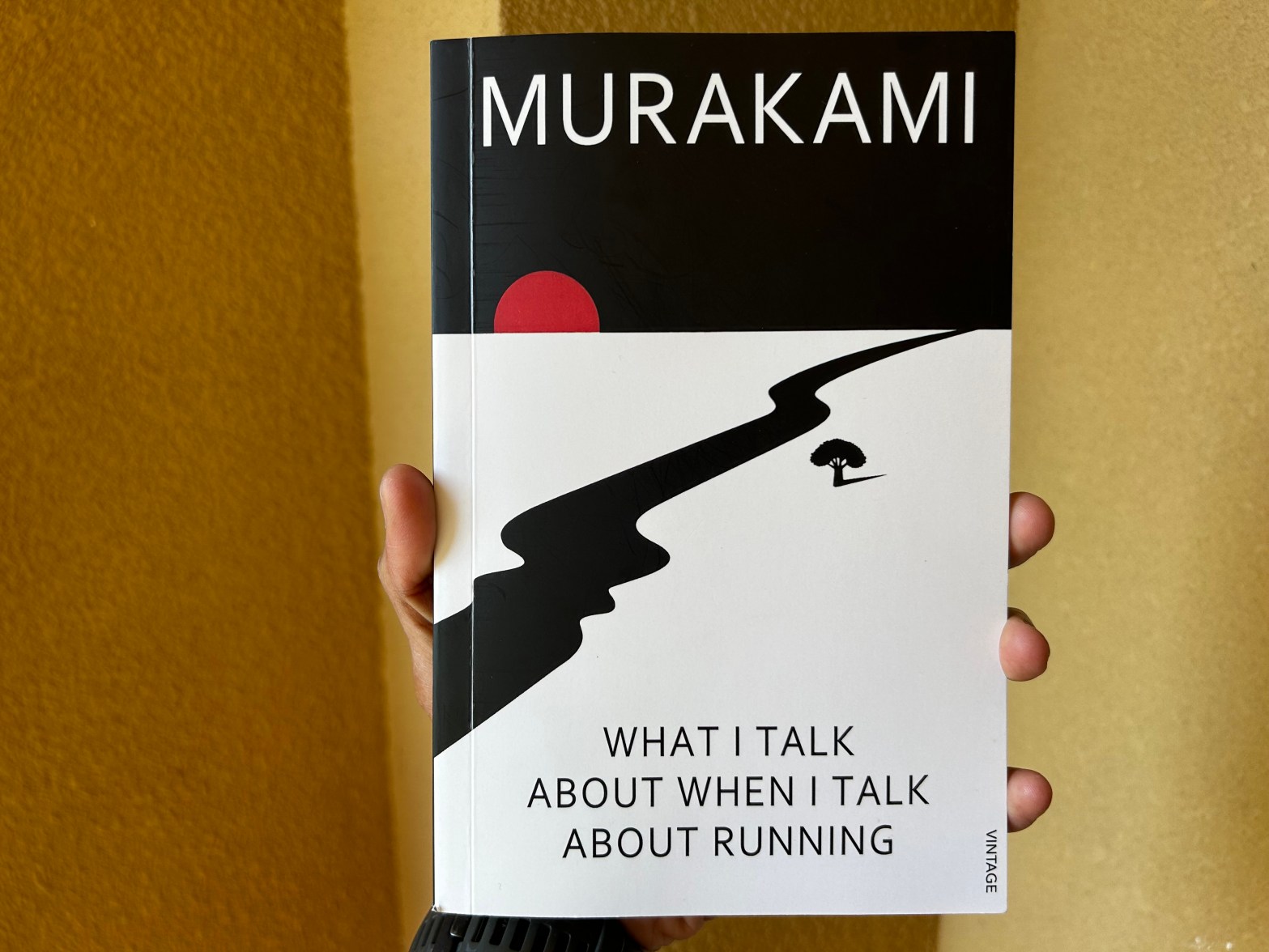
I got introduced to Haruki Murakami and his book “What I talk about when I talk about running” through the fantastic joincolossus.com Founders Episode #357: https://joincolossus.com/episode/senra-357-haruki-murakami/. (I highly recommend subscribing to joincolossus.com if you haven’t done so, the contents of their podcasts and articles are so rich and enterprising – about Founders and Business Breakdowns). The Murakami book is a memoir that he wrote over a period of time. What attracted me to his life and story was that he is both a writer and runner – A novelist who has been writing 4 to 5 hours and running 10k every day since past 40+ years! Writing has been my passion since a very long time, and running has become an endearing sport for 2 years now. He has been living a life that I have always dreamt of – reading stuff and writing professionally, and taking up running, swimming and bicycling for physical fitness. I ended up buying this book and enjoyed it very much. My take aways from this book are aplenty and I would like to use these thoughts to motivate me more into writing and running.
Mindset: Murakami starts off by writing that “Suffering is optional“. He mentions a marathon runner talking about a mantra his older brother, also a runner, had taught him: “Pain is inevitable. Suffering is optional“. Whatever worthwhile we do in life, more applicable to sports and fitness, at most point of time gives a feeling of hurt that we don’t like to take any longer. The hurt part is an unavoidable reality, but whether or not you can stand any more is up to the runner himself. Typically, long distance runners just compete with themselves to beat their own personal best. For Murakami, running is both exercise and a metaphor. Running day after day, piling up the races, bit by bit he raises the bar, and by clearing each level he elevates himself. Mindset of a runner, thus, should be to raise their own level.
Why do you run?: This question reminisces me of the same question that I have asked my “runner” friends. I used to live around a stadium in Shanghai, and one of my runner friends had urged me to make use of this glorious opportunity and take up running. When I asked him why he ran, his answer “Running clears my mind. If I have any confusion, I go for run and I get clarity“. Somehow, I wasn’t motivated at the time, and I missed making use of that glorious stadium next door. Another friend said that running saves his marriage – without runs the chap goes cranky and has negative impact on the family relationships. I don’t claim to be a big runner, but recently I have been fairly consistent, and my reason to run is the typical “runner’s high” – to enjoy those glorious endorphins released after the run, taking me to a blissful state. And Murakami’s reason? He runs to acquire a void. He listens to music while running and tries not to think anything. Naturally the thoughts do come, but they are random, and they just come and go, just like the clouds, where his mind is like the sky.
Running is not for everyone: Murakami doesn’t go around professing that running is the best thing there is, and everyone should do it and the like. Instead, he hopes that people try it out after reading his book and see if they enjoy it. He outlines three important advantages of taking up running as a sport: You don’t need anybody else to do it. You don’t need special equipment. You don’t have to go to any special place to do it. As long as you have running shoes and a good road you can run to your heart’s content. He has several other motivations for running, too. Pushing himself to his limit, he manages to heal the loneliness inside and put it in perspective. He used to smoke before and his natural desire to run even more became a power motivation to not go back to smoking and helped with the withdrawal symptoms – If you have been wanting to quit smoking, probably taking up running could help! Murakami is the type of person who doesn’t find it painful to be alone. And when he is running, he doesn’t have to talk to anybody and doesn’t have to listen to anybody. I would like to read this as running is for anyone who is at peace with themselves and would like to push towards fitness and elevate themselves.
Will Power: Murakami doesn’t believe that it’s his strong will that makes him run every day. He runs because it suits him. He agrees that “will” does play an important role, but unless it’s an activity the person really cares for, he or she won’t keep it up for long. Prerequisite to a strong will is a strong liking to an activity, one that should come from within. We tend to believe that highly successful runners have a very strong will. Interestingly, he writes about his interview with Olympic runner Toshihiko Seko, to whom he asks, “Does a runner at your level ever feel like you’d rather not run today, like you don’t want to run and would rather just sleep in?“. Seko’s reply was “Of course. All the time!“. I get this feeling every day I decide to run, where I try to cook up reasons why I shouldn’t be running today. The effort to move from the lethargic to a moving state is what requires the biggest push. It was rather heartening to find out that even the best of the best has this mental block before every run. This thought adds up perfectly to my previous article on starting from zero: https://achuthkamath.com/2025/01/04/you-always-start-from-zero/. Murakami declares with a great relief that “In the final analysis we’re all the same!“. At this critical state of mind, he reminds his mind about this luxury he has to wake up every morning to spend time in writing and running, something he really enjoys versus the rest of the folks who need to take the daily commute to office, to work in jobs they almost hate. His mind finds this reasonable and releases the mental block. Admittedly, life gets easy when we start seeing the wonderful things in our lives – of immense sense of gratitude.
Blessing in disguise: This was a completely amazing thought he put across. Murakami writes about having the kind of body that easily puts on weight and using this as a blessing, rather than a curse. If he doesn’t want to gain weight, he has to work out every day, watch what he eats and cut down on indulgences. With daily exercise, the metabolism improves, making person stronger and healthier – also having impact on ageing. People who don’t put on weight easily even after indulging themselves, don’t have a strong motive to exercise every day. He believes this could be problematic; their physical strength deteriorates as they age. Without exercise, muscles and bones will weaken. He sees his body type as a blessing, and this alone is a strong enough motivation to run every day. I bump into folks who complain that they easily bloat up, and this thought should make them get in harmony with their body type. You are lucky that the nature has enforced you to keep exercising every day. I am on the other end of the spectrum, where it’s difficult for me to put on weight. Yet, this thought is a wakeup call to exercise every day to sustain my muscles and bones and not go around declaring my body type as a blessing!
Muscle Memory: Murakami points out an interesting poster at one of the gyms he worked out at “Muscles are hard to get and easy to lose. Fat is easy to get and hard to lose”. He talks about training his body to take in the hardship – letting it know in no uncertain terms. The body is an extremely practical system, and we need to let it experience intermittent pain over time, and then the body will get the point. With this, the body might start accepting the increased amount of exercise it’s made to do. We need to gradually increase the upper limit, to ensure we don’t burn out. Through repetition we input our muscles the message that this is how much work they have to perform. Our muscles are very conscientious (who does the work assigned well and thoroughly). As long as we observe the correct procedure, they won’t complain. If we skip some activity for long time, muscles tend to forget about that. This reminds me of the nice statement about muscles, “you either use it or lose it“. He writes that muscles really are like animals, and they want to take it as easy as possible; if pressure isn’t applied to them, they relax and cancel out the memory of all that work. When he trains for important races, he maintains a certain tension by being unsparing, but not to the point of burn out. He talks about showing the muscles who the real boss here – a very interesting thought indeed.
No learning is ever wasted: I remember one of our friends telling me that at one of the Marathi culture events, Sachin Pilgaonkar shared this very important pearls of wisdom “No learning is ever wasted!”. We learn a new craft, a new language, a new skill, singing or dancing, a new sport, anything. Whatever the learnings, the mind remembers. It’s there stored somewhere at the back of the mind, and when required can be tapped into. Murakami used to run a jazz bar in Tokyo for three years, and during this time, he met all kinds of offbeat people and had some unusual encounters. He absorbed a variety of experiences that helped him in his novels. Although a lot of customers came to his bar, most might not have liked the place. His figured out that even if one out of ten enjoyed the place, that was enough, business would survive. He had to make sure that the one person who did like the place really liked it. In order to make sure he did, he made it his philosophy and stance clear-cut and patiently maintain that stance no matter what. He used this learning from his business into his writings – He wanted to write the kind of things he wanted to write, exactly the way he wanted to write them, and ensured he had a one-in-ten-repeaters, typically a young crowd. This allowed him to make a normal living, and he didn’t aspire to be literature’s top runner. This is a nice learning for a business too – Look for that 10% audience that truly value your products and offerings and focus entirely on this consumer section. The remaining 90% might not be happy with your product, they might even complain and have bad reviews, but maybe it’s not our target anyways. We got to focus on our 10% core customers to do well in business.
What makes one a great novelist? Murakami lists three important qualities a novelist needs to have. First, the talent itself. Without a literacy talent, it doesn’t matter how much effort and enthusiasm you put into it. Good analogy is that if you don’t have any fuel, even the best car won’t run. The next most important quality is focus – the ability to concentrate all your limited talents on whatever’s critical at the moment. Focus might be able to compensate for the shortage of talent. After focus, the next most important thing is endurance. Novelists need the energy to focus every day for half a year, year or two years. The analogy he provides here is of Breathing – If concentration is the process of just holding your breath, endurance is the art of slowly, quietly breathing at the same time you’re storing air in your lungs. Focus and Endurance can be acquired and sharpened through training. Sitting down every day at your desk and training yourself to focus on one point is like training your muscles for running. Discipline to write every single day and concentrate on the work at hand will gradually expand the limits to what we are able to do. He claims writing novels is a kind of manual labor for him. There is lot of work involved to focus mind like a laser beam, imagining something out of a blank horizon, creating a story, using right words, keeping the whole flow of the story on track, that requires lot of energy. This is grueling, dynamic labor going on inside the novelist, he writes. A writer puts on an outfit called narrative and thinks with his entire being and for the novelist that process requires putting into play all your physical reserve, often to the point of overexertion.
Using the learnings from running into writing: Murakami writes that he learnt a lot of practical and physical lessons that he could use for his professional writing – How much can I push myself? How much rest is appropriate – and how much is too much? How far can I take something and still keep it decent and consistent? When does it become narrow minded and inflexible? How much should I be aware of the world outside, and how much should I focus on my inner world? To what extent should I be confident in my abilities, and when should I start doubting myself? He believes his writing work would have been vastly different if he hadn’t become a long-distance runner. He also writes: Most runners run not because they want to live longer, but because they want to live life to the fullest. He believes running helps to live life to the fullest with clear goals. Exerting yourself to the fullest within your individual limits: that’s the essence of running, and a metaphor for life. Same applies to his writing as well.
Becoming a Triathlete: While one keeps living life to its fullest through running, we tend to stumble on other individual sports like bicycling and swimming – Both can be done without requiring another person, albeit with special tools (the bike) and place (the pool). Murakami participated in several triathlons, during which he gave second preference to running, as he had to focus more on biking and swimming techniques. It was quite interesting to know that he doesn’t enjoy biking at all, but then, given his mindset about challenging himself, takes it up and gets better at it. In the case of swimming, he was a self-taught, and he quickly understood that without technique it was hard to swim at ease. He found a good coach who improved his swimming quite a lot. The sudden transition from one sport to another is something that always feels odd. He writes that moving from swimming to cycling is a different feeling of weight, speed, and motor reflexes, and you use completely different muscles. You feel like a salamander that’s evolved overnight into an ostrich. When moving from cycling to running, it takes time for the muscles to change from one rail to another – the hard worked muscles while biking just won’t move smoothly.
Eternal self-critic: When around sixteen years of age, Murakami felt like a complete loser, making a mental list of all the deficiencies. He confesses that even forty years later, he lives with such a wretched feeling. He still stands in front of the mirror and lists all his physical shortcomings. At the start of a triathlon, he is again struck by how pitiful and pointless he has become, and what a lame, shabby being he is. He starts to feel like everything he has ever done in life has been a total waste. This was after his novels, essays, and short stories have been best-sellers in Japan and internationally, with his work translated into 50 languages and having sold millions of copies outside Japan. So interestingly, it looks like, all of us go through some kind of midlife crisis, after all. It just makes us human to retort to self-pity and self-critic at times, with a feeling of no accomplishments at all, even after one has had lot of success – we should consider this as very normal human condition.
Ageing gracefully: Finally, the concept of ageing gracefully, accepting and respecting the natural changes in the body forms a recurring theme in the book. He cites the example of Mick Jagger who boasted that “I’d rather be dead than still singing ‘Satisfaction’ when I’m forty-five.” He continued to sing the song well after sixty. Interesting point he mentions is that Mick Jagger couldn’t imagine himself at forty-five. He doesn’t laugh at Mick Jagger as he believes he also might have done the same when he was young. The thing is when we are young, we somehow have this feeling that growing old is at such a distant future and end up making tall claims on what we would do at that age. When we go the other side of the equation, when we age, is when we realize that we have just been naive. To age, is the rule of the game. He writes Just as a river flows to the sea, growing older and slowing down are just part of the natural scenery, and I’ve got to accept it. He agrees it might not be a very enjoyable process, but we have no choice. We need to accept this, and be grateful to our life well enjoyed, so far. Live everyday well, and with as much joy as possible, that when we age, we should have a feel that we have fully enjoyed our life. Another pearl of wisdom he writes is that one of the privileges given to those who’ve avoided dying young is the blessed right to grow old. The honor of physical decline is waiting, and you have to get used to that reality. Making peace with the ageing process is a great way to live life, indeed.
These were some points that I wanted to highlight from this amazing book. I would highly recommend picking up this book, for folks who want to take up running, or have already started running and want to do long distance. It’s quite interesting to ponder over thoughts that probably all marathoners go through. Memoirs are always a nice resource as they offer great pearls of wisdom, they have been distilled from plenty of years’ experience. Keep running!
Discover more from Keep it simple, stupid.
Subscribe to get the latest posts sent to your email.
 Keep it simple, stupid.
Loved your storytelling skills and the wonderful assimilation of your learnings from the book. Lot of take aways for myself. Thanks bud for sharing your thoughts.
LikeLike
Thanks a lot, Sushant, for your kind words of appreciation, means a lot 🙂
LikeLike
Great review 👍 👍
We like this book as well, but we prefer his other novels
The Fab Four of Cley
🙂 🙂 🙂 🙂
LikeLike
Thanks a lot Klaus! I haven’t got chance to read other books of his. Another German friend of mine told he read other books by Mr.Haruki Murakami, is he very popular in Germany?
LikeLiked by 1 person
Indeed, he is. He is also popular in the UK. Scott Pack, who ran Waterstones’ buying team in the early 2000s, is a big Murakami fan and gave him lots of attention.
LikeLike
I see, that’s very nice, thanks for the info!
LikeLiked by 1 person