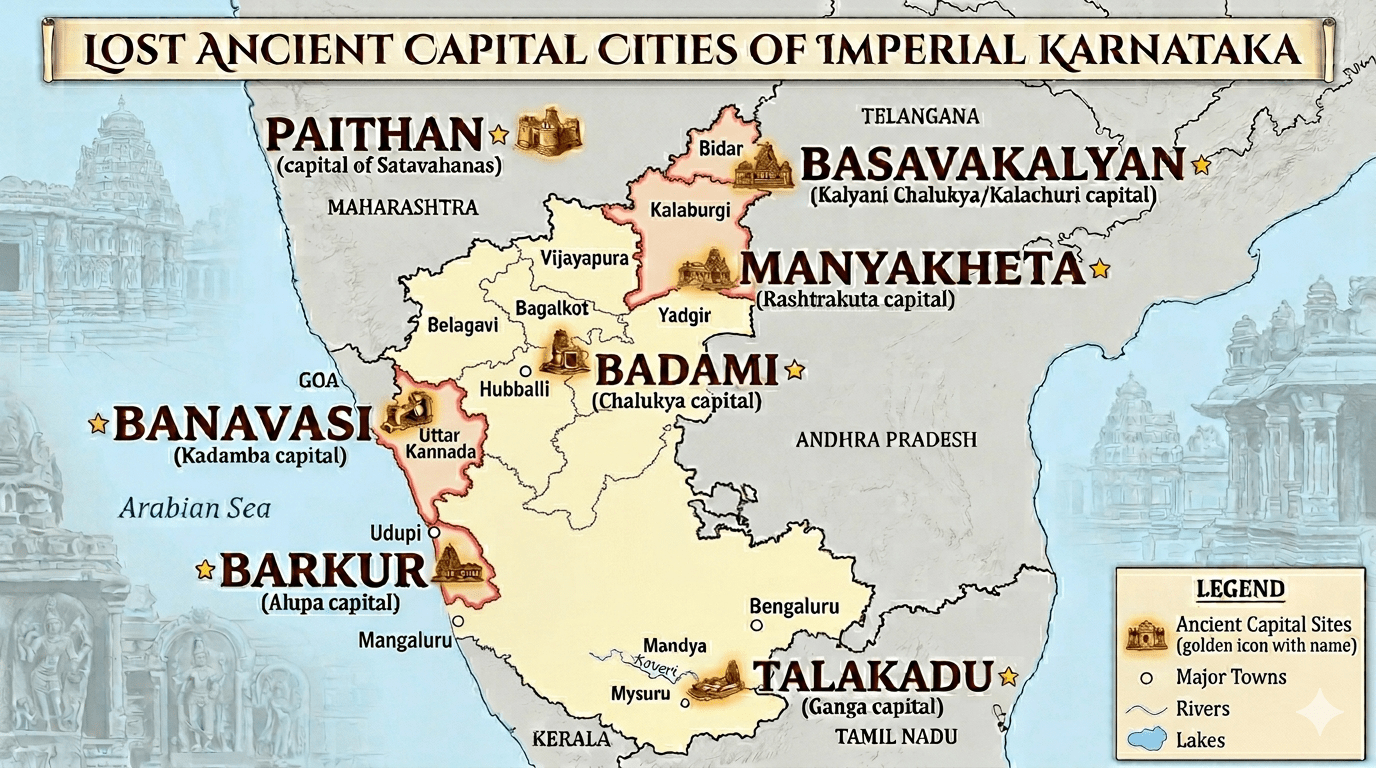
One of the best books I ever read on global history is “The Silk roads” by Peter Frankopan, one whose detailed review I made into a two-part blog. In Part-2 of that blog, I highlighted some of the historic capital cities, some transformed but others forgotten. Closer to home, in and around my state of Karnataka, we have had several important dynasties, and their capitals have since been completely forgotten. They are now in ruins. No, I am not talking of Hampi, the glorious capital of the mighty Vijayanagara Empire, this still gets a fair share of footfall and remembrance, mostly due to its recent history. Karnataka (although not accredited as state back then) was ruled by prominent dynasties in the early centuries of the 1st millennium CE. Let’s take a look at some of these once-prosperous capitals. Interestingly, this also serves as a sequel to the blog I wrote last November about the capital cities and ancient kingdoms of Karnataka. It’s time to dive a little into some early history of Karnataka.
Pratisthana (Paithan): Between 2nd century BCE to 2nd century CE, Satavahanas ruled this land, from their capital city Paithan. At its peak, the empire covered modern Maharashtra, Telangana, Andhra Pradesh, and parts of Gujarat, Karnataka, and Madhya Pradesh. Situated on the banks of Godavari River, in modern day Maharashtra, Paithan is now associated with many spiritual leaders of all faiths. It was a very important city of its time, and one of the few inland towns mentioned in the famous first-century Greek book, the Periplus of the Erythraean Sea. Today it continues to be religious, textile and cultural hub, but the political importance has completely waned.
Banavasi: The Chutu dynasty initially assisted the Satavahanas in ruling the northern/central Karnataka and later declared independence once Satavahana power declined. They ruled from Banavasi, in present-day Uttara Kannada district from the 1st to 3rd century until the Kadambas toppled them. Kadama dynasty, the first homegrown native Kannadiga empire, rose in the mid-4th century CE and continued to use Banavasi as their capital city. A beautiful Shiva temple Madhukeshwara temple was built here, and the city flourished during Kadamba dynasty rule. It lost its political importance when the Badami Chalukyas rose to power in the mid-6th century and overthrew the Kadambas. It might have been sacked during this war; we won’t be sure. It slowly faded away in ancient history as it changed hands from Badami Chalukyas, to the Rashtrakutas, to the Hoysalas and to the Vijayanagara empire.
Barakkanur (Barkuru): The Alupas ruled the Tulunadu region (coastal southern Karnataka) from the 3rd century until 15th century, yeah, a very long span! Although they ruled mostly from their capital city of Mangalore, they kept moving their capital between Mangalore and Udyavara until the 10th century and later moved to Barkuru. A prominent kingdom of coastal Karnataka, the Alupas had two things working for them – first was the western ghats acting as a natural boundary from the other reaches of Karnataka, and second their choice of diplomacy and subordination rather than confrontation. This explains how they “survived” through 12 centuries, while one mighty kingdom rose after another in north-central Karnataka. Home to temples and Jain Basadis, the area although became a Vijayanagara province, its significance soon faded away.
Talakadu: Southern Karnataka was ruled by one of the longest serving dynasties of southern India, the western Gangas. Their capital during their middle phase (6th to 10th century CE), Talakadu, flourished until the Gangas were defeated by the Cholas in the 10th century. It then passed to the Hoysala empire, and eventually the Vijayanagara empire. The new empires had capitals elsewhere, and this city lost its political importance. In the 16th-17th century, large parts of Talakadu got buried under sand dunes, possibly due to floods, shifts in river course, and wind-blown sand accumulation. Today, although it’s still popular with tourists for the temples and sand dunes, the city’s significance is reduced to being just another tourist spot near Bangalore.
Vatapi (Badami): One of the most decorated homegrown empires of Karnataka, the Badami Chalukyas, ruled a vast breadth of southern and central India between the 6th to 8th century. Badami, their glorious capital, in the present day Bagalkot district was chosen by the founding Chalukyan king Pulakeshin I strategically owing to its geographical protection by rugged sandstone cliffs. It remained the capital of Badami Chalukyas while they ruled much of Karnataka, Maharashtra, parts of Tamil Nadu and Andhra Pradesh between the 6th and 8th centuries. One of the legacies of this town is also the famous Vatapi Ganapatim hymn dedicated to the Ganapathi idol brought from Vatapi to Tamilnadu by the Pallava general during their conquest of Chalukyas. The city lost its significance as the dynasty crumbled and gave way to another, even mightier empire, ruling from a different capital city.
Manyakheta (Malkheda): The mightiest of all Karnataka empires and one of India’s greatest dynasties, the Rashtrakuta empire, at their peak, ruled almost the whole of present-day India, between 8th to 10th century. The legendary Monarch Amoghavarsha Rashrakuta built this imperial capital, and in its heydays, all roads led to Manyaketa, in present day Kalaburgi district. Poets, artists, traders, all flocked to this great city to try their luck. Foreign travelers got mesmerized by what they saw. Sulaiman, the 9th century Arab merchant and traveler, who visited Amoghavarsha during his time, in his work silsilat-al-tawarik, described the Rashtrakuta empire as one of the four great contemporary empires of the world. Let that sink in – One of the four great empires at the time – other three being the Arab, the Chinese and the Byzantine empires. The Rashtrakuta dynasty fought many wars and finally fell when the Paramara King Harsha Siyaka sacked the capital Manyakheta. The city was later used by the Chalukyas of Kalyani as their base. During the Chola-Western Chalukyan conflicts, the city was dealt one final blow when Rajendra Chola attacked and completely destroyed the city – so comprehensively that today nobody knows the exact location of the Rashtrakuta capital. The city has never recovered since and remains is complete oblivion – so much that even people of Kalaburgi don’t know or care much about. Of all the lost capitals, I feel this one was the most powerful and now the most forgotten, quite unfortunate.
Kalyani (Basavakalyan): The royal capital of Kalyani Chalukyas from 1050 CE to 1189 CE, it was taken over by the Kalachuris as their capital, in their brief rule during 1156 CE to 1184 CE. Although a prominent city for social and religious movements, it never had that imperial status like Badami or Manyakheta. Initially named Kalyani, the city in modern day Bidar district, was renamed to Basavakalyan after India’s independence, in the honor of the social reformer, Basavanna. Interestingly he was also the chief minister of Kalachuri kingdom. Being one of the more recent capital cities, it still continues to be an important industrial hub in the Bidar district, but not much political significance.
So, there it is – the legendary ancient kingdoms, ruling from different parts of Karnataka, their capitals spread across the breadth of this great land. Bangalore is the most sought-after city in Karnataka today, its political and economic capital. Although a lot of political and demographic changes have happened over the years, we must give all these historic capitals their due and maintain the legacy left behind by Karnataka’s great empires. We must never forget the rich history of Imperial Kannada Nadu!
Discover more from Keep it simple, stupid.
Subscribe to get the latest posts sent to your email.
 Keep it simple, stupid.
Fascinating piece of history! It’s amazing to learn about Karnataka’s forgotten capitals and their rich heritage.
LikeLike