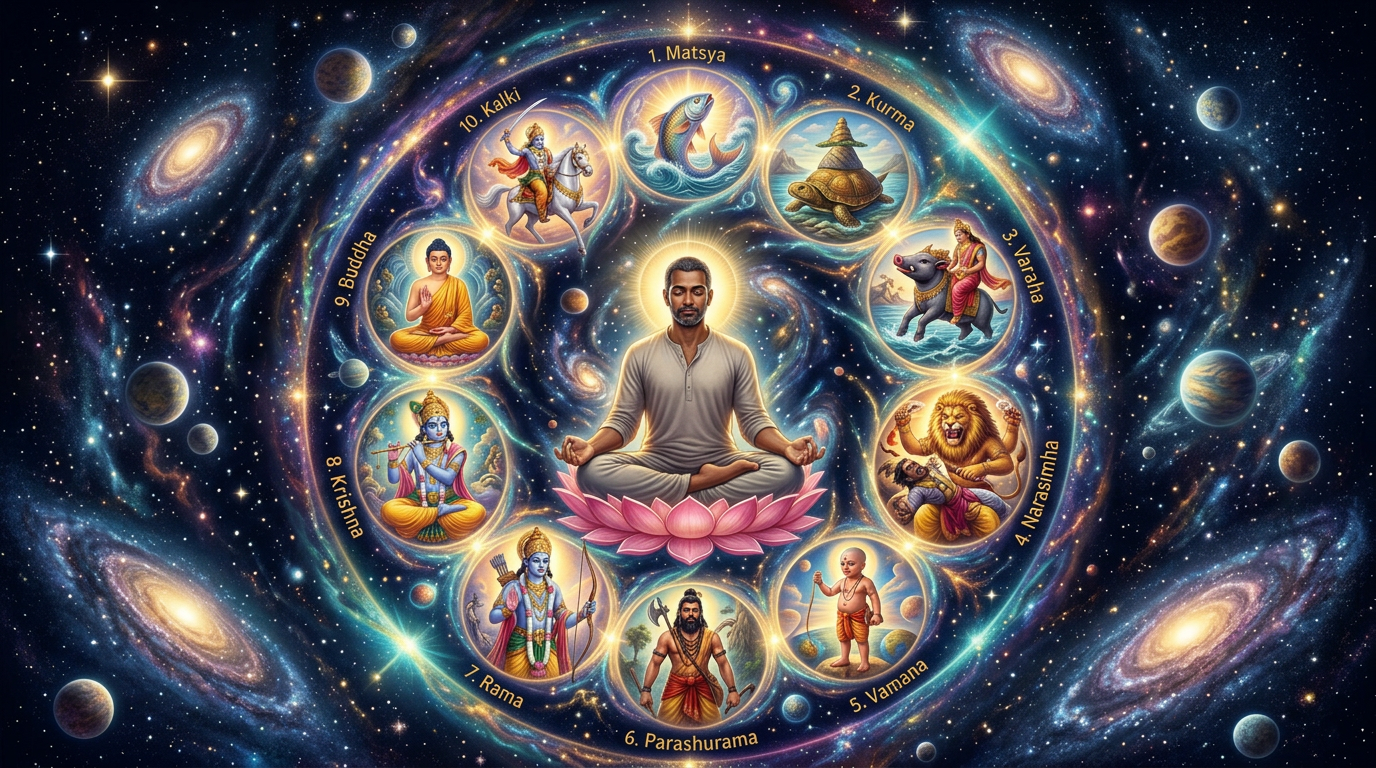
We Indians have grown up with the legend of Dasha-Avatara – the ten avatars (incarnations) of Lord Vishnu. The belief goes that whenever there is serious problem here on earth, impacting life, mostly the course of humanity, Lord Vishnu, the preserver god from the holy Trinity comes to protect us all. The ten avatars can be interpreted as a symbolic pattern in the biological, civilizational and spiritual evolution of Homo sapiens. One thought predominates the entire avatar philosophy – Evolution must continue and in the benefit of the human race. Whosoever or whatsoever disturbs this cycle will be considered an evil and is bound to be destroyed.
From water, the primary source of vitality here on Earth, emerged the first organisms able to survive only under water – Matsya the fish was born. Slowly life moved to land, where we had creatures that lived both under water and land – the amphibians – Kurma the tortoise. Amphibians slowly evolved into land mammals – first the herbivorous and then the carnivores. We had Varaha the wild boar and then Narasimha the half lion, half human form, a mix of carnivore and homo sapiens, representing a gradual transition from animal to human form. It’s established that the early human forms were dwarfs, of short stature, which got represented by the Vamana avatar.
From here, evolution took a moral and social form – homo sapiens moved on to the Iron ages, wielding iron axes, represented by the Parashurama Avatar. Gradually, homo sapiens got domesticated, kingdoms were formed, kings and leaders start ruling and establishing the law of land, represented by the Rama Avatar. Based on whom we ask, we can either consider Balarama (representing the agrarian movement) and Krishna (the political movement), or Krishna and Buddha (inner reform & awakening) as the next two Avatars. The final avatar, yet to arrive, the Kalki avatar is the terminator of sorts, born to free the human race from greed, consumption and status in the current kali yuga.
Given this discourse, it’s reasonable to believe that Lord Vishnu is a manifestation of humans, representing an era (yuga) of the Homo sapiens, fighting the dominant evil at the time and coming out victorious. Good and Evil, though, just represent the state of consciousness and moral orientation at the time. I have always loved this brilliant line in the “Pal pal hai bhaari” song from the Hindi movie Swades – Mann se Ravan jo nikhale Ram uske mann mein hai – One who removes Ravan from their mind, there is Ram in their mind. The same human can be Ram or Ravan, just by changing their state of mind and consciousness. In Hindu philosophy, it’s quite interesting how we all humans are scrutinized under a grey lens – not just black and white.
Matysa: Before the fish life, there were a host of organisms, starting from the simple molecules, single celled organisms, bacteria, multicellular organisms, and soft-bodied marine organisms. But what makes fish special to win the spot as the first Avatar is that it laid a solid foundation to carry evolutionary memory forward – with its spinal column, nervous system, movement with a purpose, thus becoming the first most complex water creature. So, although Matsya is not the first life on earth, life became capable of carrying wisdom forward through a fish. Matsya kills Hayagriva, the one who hid the Vedic knowledge in cosmic ocean and restores it back. Hayagriva represents the principle of Intelligence without humility (carry the right evolutionary memory) and misuse of knowledge (use it for propagation) – this impacted the evolution in the long term and hence had to be destroyed. Matsya preserved life in water!
Kurma: Life moved on, and species got an upgrade to live both in water and land – the amphibians. The frogs, snakes, crocodiles and the likes, so what is unique about Kurma the tortoise? Why that represents the next ‘Avatar’? The tortoise is an epitome of stability and patience – Moves slowly but steadily, has tremendous patience, it’s not aggressive, slithering or jumpy. It doesn’t run away (from problems?), has unique self-protection mechanism when under threat. And most importantly, it just lives longer – this goes to show how much we humans are fascinated about living longer. This Avatar is a neutral one, not taking sides, the universe needed someone to steady the ship when there was intense competition between the Devas and the Asuras. Kurma supports Mount Mandara through the act of samudra manthan – the churning of Ocean. The Kurma avatar, with its shell representing the mountain & land, provided stability for further evolution. It laid a foundation for the next generation of species to evolve, to thrive and to compete (like the devas and the asuras). Kurma made the land possible!
Varaha: Land emerged out of water, but the rich nutrients and fertility were hidden deep inside the earth. There was a need for some species to dig, uproot, plough the land and bring what lay buried inside to the surface. No animal did this better than the wild boar – the Varaha. The strength, the aggression and the fearlessness was the need of the hour to take evolution forward. Elephant was too advanced, bull came up only in later representations, and the horse represents speed and warfare – wild boar was apt. Hiranyaksha, the asura who represents dis-order and the hoarding of Hiranya (gold – maybe the rich-nutrients?) had to be slayed. Varaha did the job and energized the evolution. Varaha claimed the land!
Narasimha: Evolution continued to carnivores, and a period of co-existence between multiple animals. Narasimha, a half-lion, half-man, picturized as a half-beast, half-human was appropriate for this phase when the humans had primal instinct. Probably an indicator of Paleolithic age or tribal consciousness, this avatar reflects the rage, the beast inside as the asura king Hiranyakashipu is ripped apart. The aggression seemed relevant at this point in human evolution when it was about the winner takes all. Brute force and raw strength determined whether one lived or perished – successfully hunt down a meal or became a meal themselves. Hiranyakashipu literally meaning “one immersed in gold and comfort” believed that he could control everything. Narasimha showed to Hiranyakashipu that reality cannot be completely controlled. Narasimha unleashed the animal instinct!
Vamana: Aggression was not enough to over-power the mighty Asura King Mahabali. Although generous and just, he was an untamed expansionist. This conflicted with the civilization ethos of the time and there was a need for someone to restrain this power. Vamana came along as a dwarf brahmin, in a way also representing the early humans of very short stature. The story goes that Mahabali had to concede three steps as gift to this dwarf Brahmin. Vamana takes one step to conquer the earth, another for heaven. The generous Mahabali bows his head down as Vamana takes his third step to send him to the nether land. Civilization thus emerges with boundaries and structures, to tame the unchecked desires of individuals. Vamana took the baby steps to civilization.
Parashurama: Human societies, now firmly settled into agricultural life, entered the Iron Age with the widespread use of iron tools. Civilization had been built; borders had been drawn and kingdoms established. Territorial wars are fought; the kings started feeling entitled and dangers of institutionalized power became a reality. Wrongs committed by the higher up in the pecking order had to be dealt with by someone. Parashurama picked the iron axe and dismantled the presumptuous royalty. The iron age humans used iron axes to create, build and reshape territories through constructive destruction. Parashurama saved civilization from its own rulers.
Rama: It’s easy to critique and tell everyone what’s right or wrong. What’s tough though, is to show how it’s done right, to lead by example. The avatars so far professed the human race that aggression was not right, that humility without self-restraint was not ideal, and that institutionalized adharma had to be dealt with. But someone had to demonstrate how it had to be rightly done – A king with high morality, duty-bound and respect for boundaries. Rama, the seventh avatar, with no apparent superpowers descended to Earth and established the Rama Rajya. Ravana was a mighty and successful ruler, but his ego let him down the path of excess and arrogance. Pride hath a fall and the victory of good over evil was celebrated with the severing of Ravana’s ten heads. Rama defined the moral order and power restrained by Dharma.
Krishna: Humans moved on from Rama-Rajya and politics became pre-dominant. Concepts of Dharma and morality started to get ambiguous and civilization by this time had become mentally complex to remain stable. Krishna descended as the eighth avatar of Vishnu into this world of mental chaos. For Krishna, nothing was black or white, he looked from his “grey” lens and devised different strategies to overcome challenges. Krishna demonstrated that preserving Dharma in a morally fractured world sometimes required unconventional strategies. Humans and their brains had got very complex by this period, and someone had to preach them about it. Krishna made humanity self-aware of its own complexity.
Balarama: Civilization had been firmly established, with agriculture sustaining the growing population. This was a very important phase of human evolution, where the homo sapiens stopped foraging and hunting, and started settling and domesticating crops (or is it the other way round?). Some traditions hence consider Balarama as one of the avatars of Vishnu. Balarama, Krishna’s brother is seen carrying a plough and mace, highlighting the need for labor strength, endurance and vitality. If Parashurama’s axe cleared the land, Balarama’s plough made that land sustain civilization. Balarama ploughed the land and represented grounded civilizational strength.
Buddha: The human brain is the most complex of all living beings – this can be good or bad. We have seen both great things and evil accomplished through this instrument. There was a need to introspect the human life, acknowledge the complexity, but remain calm and composed at the same time. Hence, some traditions consider Buddha, the enlightened one as one of the recent Avatars of Lord Vishnu. Some people, especially the Buddhists, might argue that this was probably done to attach Buddhism as a spin-off of Hinduism. But the flow of human evolution follows this interesting pattern, when the mind becomes the most important organ of Human body, and had to be tamed. Buddha tamed the mind and let humans introspect.
Kalki: My grandmother used to refer to a term “kali” (pronounced kuh-lee) to point to indiscipline and lethargy. She despised laziness to the core and was very vocal about staying physically active. We have an epidemic of comfort crisis and people are moving less but eating more than required. Food, grocery, anything and everything comes to our doorsteps these days. In the long history of human evolution, this tiny period of comfort crisis has started undoing ages of progressive human evolution. Then there is increasing greed, consumption and status, these are the other “kali” in our society today. The evil is now part of the humans and is slowly destroying humanity. An avatar must arise to remind fellow humans of the detriments of this modern culture – A Kalki avatar riding a horse (representing movement, strength and agility – three pillars of human vitality) and holding a sword (to cut ignorance, greed and excesses). Kalki brings the vitality and renewal to the human race.
We humans have evolved in an incredible fashion over millennia, and this process continues as the life moves on. Avatars represent the major pivots in this evolutionary story, one that ultimately benefited the human race. Another interesting point is that the enemy too evolves with humanity. The earliest avatars confront floods and cosmic instability. Later avatars confront tyrants. Still later, they confront ego, ambition and moral complexity. Finally, Kalki confronts the darkness within humanity itself. As they say, “It takes a village to raise a child“, so does humanity need these Avatars to propel the human race into sustained periods of positive development. If every age produces its own Asura, every age must also awaken its own Avatar. We have come a long way, and we should all seek out the Kalki in each one of us to defeat the ignorance of our modern society. The human race must continue to thrive!
Discover more from Keep it simple, stupid.
Subscribe to get the latest posts sent to your email.

